US lifts restrictions on Anthropic AI models as cybersecurity concerns mount
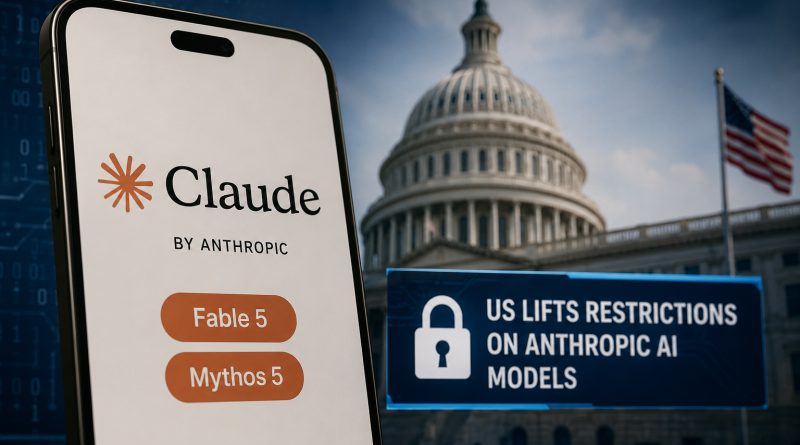
The United States government has lifted export controls on Anthropic’s latest Claude models, clearing the way for the company to restore broader access after a sudden restriction tied to national security and cybersecurity concerns.
Anthropic said access to Claude Fable 5 and Claude Mythos 5 had been restored after the Department of Commerce lifted controls that were imposed in June. The company said Fable 5 would become available globally across Claude products from July 1, while Mythos 5 access has been restored for a set of US organisations approved by the government, with Anthropic continuing talks to expand access to additional domestic and international partners.
The restrictions were introduced on June 12, shortly after the release of the two models. Anthropic said the order required it to prevent foreign nationals from accessing the systems, including users outside the US and foreign national employees working inside the country. Because the company could not reliably verify nationality in real time, it suspended both models for all users.
The decision followed concerns that one of the models could be manipulated into bypassing safeguards. According to Anthropic, a report from Amazon researchers identified a method that could prompt Fable 5 to find software vulnerabilities, including one example in which the model produced code showing how a flaw could be exploited.
The episode has intensified debate about how governments and technology companies should manage frontier AI systems that may be useful for both cyber defence and cyber offence. Advanced models can help security teams detect vulnerabilities faster, analyse code, and strengthen digital infrastructure. The same capabilities, if misused, could also assist malicious actors seeking to identify weaknesses in software or critical systems.
Anthropic said it had introduced an improved safety classifier designed to block the behaviour identified in the Amazon report. The company also said the specific technique described in that report is now blocked in more than 99 per cent of cases, although it acknowledged that no AI model can be made completely resistant to jailbreak attempts.
The company is now working with Amazon, Microsoft, Google and other partners on a proposed industry framework for assessing the severity of AI jailbreaks. The framework aims to give developers and governments a more consistent way to judge whether a bypass meaningfully increases an attacker’s capability, how broad that capability is, how easily it can be weaponised, and how easily others could discover the same method.
The restrictions on Anthropic also come as Washington takes a more active role in reviewing advanced AI releases. Associated Press reported that OpenAI has also limited access to its GPT-5.6 Sol model to selected government-approved customers for a temporary period, following requests from the Trump administration.
For businesses, the dispute is a reminder that artificial intelligence is reshaping cybersecurity on both sides of the equation. As AI systems become more capable, organisations will need to strengthen staff awareness, technical controls and incident readiness, rather than relying on software safeguards alone.
To improve your own cybersecurity defences, consider taking The Hack Academy’s online training programme, which offers courses covering fundamentals of cyber security, Linux, cryptography, networking, internet vulnerabilities, cloud security, penetration testing and advanced penetration testing. The programme includes theory, quizzes, video content and practical virtual labs designed to help learners build real-world security skills.