
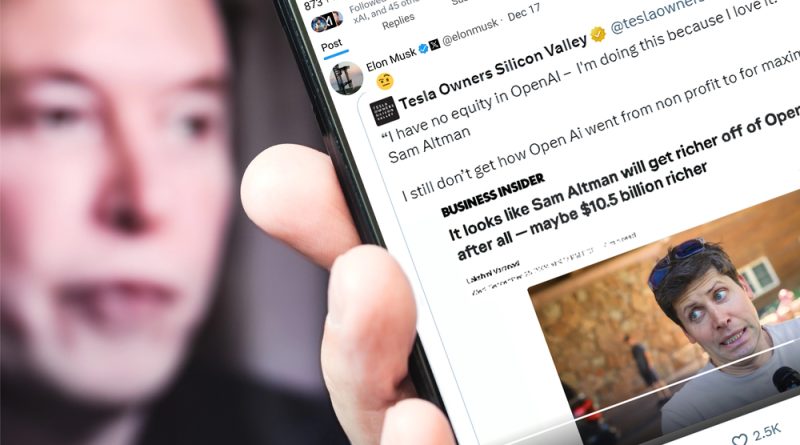
Elon Musk, OpenAI And The Courtroom Collapse Of AI’s Moral High Ground
The legal fight between Elon Musk and OpenAI was never just a dispute about corporate structure. It was a fight over origin stories, control, money, ego and the increasingly uncomfortable question at the centre of the artificial intelligence boom: who gets to decide what serving humanity actually means?
By the time the courtroom drama reached its conclusion in Oakland, California, the case had become something larger than a private feud between billionaires and former collaborators. It had turned into a public excavation of the AI industry’s founding mythology, exposing the gap between lofty public promises and the brutal private realities of power, capital and ambition.
For a company that began life with the language of public benefit, OpenAI’s rise has always depended on a delicate balance. It needed to persuade the world that it was building transformative technology responsibly, while also raising the vast sums required to compete in a field dominated by the richest technology companies on earth. Musk’s lawsuit attacked that contradiction directly, alleging that OpenAI and its leaders had betrayed the nonprofit mission he helped fund and support. OpenAI, for its part, argued that Musk’s case was less about principle and more about rivalry, especially after he founded xAI as a direct competitor. A federal jury ultimately ruled against Musk in May 2026, finding that he had waited too long to bring his claims.
The verdict may have favoured OpenAI, but the proceedings did little to leave either side looking noble. Instead, they made one thing painfully clear: in the race to control artificial intelligence, nobody’s hands look entirely clean.
The Memo That Captured The Original Divide
The conflict can be traced back to OpenAI’s early years, when the organisation was still structured as a nonprofit research lab and was publicly framed as a counterweight to the commercial incentives of big technology.
In January 2018, OpenAI co-founder Greg Brockman reportedly sent Musk a lengthy memo rejecting the idea that the lab should be folded into Tesla. Musk had been pushing for a structure that would provide OpenAI with deeper resources, while also giving him control. The argument, at least in public facing terms, was that artificial intelligence was too important to be left to conventional corporate incentives.
Brockman’s memo pushed back using the same moral vocabulary. His case was that OpenAI’s strength lay not only in research talent, but in its ethical positioning. If the lab became absorbed into Tesla, it would lose the very independence that made its mission credible.
That 2018 disagreement now looks less like a footnote and more like the opening scene in the long breakdown between Musk, Sam Altman, Brockman and the organisation they helped create.
At the time, the fight was framed around mission. Who could best protect humanity from the risks of advanced AI? Was it safer for OpenAI to remain independent, even if that meant fewer resources? Or did the scale of the challenge require the infrastructure and capital of a company like Tesla?
Years later, the courtroom would revisit those questions in a much harsher light. The language of duty to humanity remained, but it was now surrounded by claims about control, profit, personal enrichment, corporate governance and broken trust.
From Nonprofit Idealism To Corporate Superpower
OpenAI’s transformation has been one of the most consequential business stories of the AI era.
Founded in 2015 as a nonprofit research organisation, OpenAI positioned itself as a mission driven lab dedicated to ensuring artificial general intelligence would benefit humanity. But the financial demands of frontier AI research quickly created pressure. Training advanced models requires enormous computing power, elite engineering talent and deep infrastructure. The nonprofit model alone was unlikely to support that scale.
OpenAI later created a capped profit structure, then deepened its partnership with Microsoft, which invested billions and became a crucial provider of cloud computing infrastructure. That partnership helped OpenAI move from research lab to global technology force, especially after the launch of ChatGPT turned generative AI into a mainstream phenomenon.
To supporters, the evolution was practical. OpenAI needed capital to compete with Google, Meta, Anthropic and other AI giants. Without serious funding, the argument went, the organisation would have been unable to build or safely deploy the technology it was created to steward.
To critics, the shift looked like a betrayal. A lab founded to resist the incentives of big technology had become deeply intertwined with one of the largest technology companies in the world. Its products were commercialised, its valuation soared and its leaders became central figures in a new industrial race.
Musk’s lawsuit attempted to turn that discomfort into a legal case. He argued that OpenAI had strayed from its founding agreement and that its leaders had used the nonprofit’s origins to build a commercially valuable enterprise. OpenAI denied the allegations and characterised Musk’s actions as part of a broader campaign against the company.
A Trial About Time, Not Just Truth
The most striking part of the legal outcome was that the jury’s decision did not fully settle the moral argument. It rejected Musk’s case because of timing.
In May 2026, a jury found that Musk had brought his claims too late. Reuters reported that the verdict was reached in less than two hours, and that the judge indicated a potential appeal would face significant difficulty. Musk said he planned to appeal.
That distinction matters. The ruling was a legal victory for OpenAI, Altman and Brockman. But for public perception, the courtroom exposed a messier story. The trial surfaced years of internal tensions, competing recollections, bruised relationships and uncomfortable questions about how OpenAI became what it is today.
Musk’s critics saw the case as hypocrisy. After all, he had reportedly pushed for OpenAI to merge with Tesla, a move that would have given him substantial control over the lab he later accused of abandoning its independence. OpenAI’s defenders could argue that Musk was not merely trying to preserve a nonprofit mission, he was trying to win a power struggle that he lost.
OpenAI’s critics, however, saw the trial as confirmation of a different concern. Even if Musk’s claims were legally late, the broader discomfort remained. A nonprofit born from warnings about the dangers of concentrated AI power had evolved into a heavily commercialised company with enormous financial backing and global influence.
The result was a strange kind of mutual humiliation. Musk lost in court. OpenAI won the verdict. But the AI industry’s moral image took another hit.
The Fight Over Who Owns The Future
At the heart of the case was a deeper question: can any private organisation credibly claim to be building artificial intelligence for humanity while also operating inside the incentives of corporate capitalism?
OpenAI’s answer has been that mission and scale require compromise. To build safely, it needs resources. To get resources, it needs investors, infrastructure and commercial products. To compete with rival AI companies, it needs to move quickly enough not to be left behind.
Musk’s argument, stripped of legal framing, was that the compromise had gone too far. In his version of events, OpenAI’s leaders had taken a public spirited project and turned it into a vehicle for private gain.
But Musk is not an outsider to the logic of technological empire. He runs Tesla, SpaceX, X, Neuralink and xAI. He has repeatedly argued that his companies serve civilisational goals, from sustainable energy to multiplanetary survival to AI safety. His critique of OpenAI therefore carries a contradiction of its own. He objects to concentrated AI power, while building another centre of concentrated AI power.
That is why the trial fascinated the technology world. It was not simply a dispute between an altruist and a profiteer. It was a battle between rival visions of control, each wrapped in language about humanity’s future.
The courtroom drama revealed how difficult it has become to separate ethical concern from competitive positioning. In the AI industry, safety arguments can be sincere, strategic or both at once.
OpenAI’s Public Trust Problem
OpenAI entered the trial as one of the most powerful and recognisable names in technology. It also entered with a trust problem.
The company had already endured the extraordinary leadership crisis of November 2023, when Altman was briefly removed as CEO by OpenAI’s board before returning days later after pressure from employees and investors. That episode raised questions about governance, transparency and the tension between OpenAI’s nonprofit oversight structure and commercial momentum.
The Musk lawsuit added another layer. It pulled OpenAI’s origin story back into public view and forced the company to defend not only its legal conduct, but its moral continuity.
This is especially important because AI companies rely heavily on trust. They ask users, businesses, governments and regulators to believe that they are capable of managing technology with potentially enormous social consequences. They promise safety, alignment, transparency and public benefit, while simultaneously racing for market share, investment and dominance.
The problem is not unique to OpenAI. The entire AI sector is wrestling with the same contradiction. Companies want to be seen as guardians of a powerful technology, but their incentives often resemble those of any other high growth technology business.
The Musk case sharpened that contradiction into courtroom spectacle.
Musk’s Own Credibility Gap
Musk’s position was not without its own problems.
His history with OpenAI is complicated by the fact that he was once closely involved with the organisation and reportedly sought greater control before leaving. He later founded xAI, which competes directly in the same field. That made it easier for OpenAI to portray the lawsuit as a business conflict dressed up as a moral crusade.
There is also the broader question of Musk’s public persona. He remains one of the most influential entrepreneurs in the world, but his political interventions, platform ownership, public feuds and erratic communications have made him a polarising figure. In a case about trust and motives, that matters.
Musk’s critique of OpenAI resonated with people who are uneasy about the commercialisation of frontier AI. But his credibility as the messenger was always vulnerable to attack. Was he defending a nonprofit mission, or trying to punish a company that escaped his control? Was he warning about dangerous concentration of power, or angry that the power was no longer his?
The court did not need to answer those questions directly. The statute of limitations issue was enough. But in the public arena, those doubts shaped how the case was received.
A Victory That Does Not End The Argument
OpenAI’s legal win removed a major obstacle, particularly as the company continues to pursue enormous capital requirements and a more conventional corporate future. Reuters reported that the verdict cleared a significant barrier to OpenAI’s potential public market ambitions.
But the verdict does not resolve the central public concern.
The AI industry is still asking society to accept a remarkable premise: that a small number of private companies, funded by enormous pools of capital, should build and deploy systems that may reshape labour, information, education, warfare, creativity and governance.
Those companies insist they are acting responsibly. They publish safety frameworks, create oversight teams, speak in careful language about alignment and point to their technical expertise. Yet their behaviour increasingly resembles that of other dominant technology firms, pursuing market power, platform control and investor returns.
That is why the OpenAI case mattered beyond the personalities involved. It showed how quickly the idealism of AI can become entangled with the oldest questions in business: who owns the asset, who controls the board, who captures the value and who gets left out?
The phrase “benefit humanity” sounds noble. In court, it became something more contested, almost like a brand claim that each side wanted to own.
The Billionaire Feud The AI Industry Did Not Need
Artificial intelligence companies were already facing public suspicion before Musk and OpenAI began airing their grievances in court.
People are worried about job displacement, misinformation, copyright, surveillance, bias, energy consumption, deepfakes and the possibility that advanced AI systems could concentrate even more wealth and power in the hands of a few corporations.
Against that backdrop, the Musk and OpenAI trial was damaging because it reinforced the impression that the future is being fought over by a small circle of powerful insiders.
The courtroom drama had all the ingredients of modern tech spectacle: billionaires, leaked communications, old rivalries, nonprofit idealism, corporate restructuring, Microsoft’s shadow, allegations of betrayal and a technology that everyone agrees could be world changing.
What it lacked was a reassuring sense that the public interest was truly in charge.
That is the humiliating part. Not just for Musk. Not just for OpenAI. For the AI industry itself.
A sector that constantly talks about responsibility and human benefit found itself reduced to a bitter dispute over control, timing and money.
What The Case Reveals About AI Governance
The Musk and OpenAI feud shows why AI governance cannot depend solely on the intentions of founders.
Founders leave. Boards change. Investors arrive. Commercial pressures grow. Products launch. Competitors emerge. The mission statements remain, but the incentives shift around them.
If society wants AI systems to be developed in the public interest, governance has to be stronger than personal trust. It has to be enforceable, transparent and resilient to power struggles. It must account for conflicts between safety and speed, openness and security, public benefit and private capital.
The OpenAI story is a case study in how hard that is.
Its original nonprofit framing gave it moral authority. Its later commercial success gave it power. But combining those two things has created lasting tension. The company wants to be both mission guardian and market leader. That may be possible, but it requires levels of transparency and accountability that the public has not yet fully seen.
Musk’s lawsuit may be over for now, pending appeal, but the governance questions remain very much alive.
The End Of Innocence For The AI Boom
The broader lesson is that the AI industry has entered a new phase.
The early period was defined by wonder, fear and experimentation. The current period is defined by infrastructure, money, legal fights and political power. AI is no longer a research frontier alone. It is an economic system, a regulatory challenge and a geopolitical priority.
That shift makes disputes like Musk v OpenAI inevitable. As the value of AI companies rises, the battles over ownership and control will intensify. As the technology becomes more important, the gap between public interest language and private incentive will face greater scrutiny.
OpenAI may have won in court, but the trial showed that reputational victory is harder to secure than legal victory.
Musk may have lost this round, but his criticism of OpenAI’s transformation speaks to a real public anxiety about whether AI development is being governed in the interests of everyone, or primarily in the interests of those positioned to profit.
Both things can be true at once. Musk’s lawsuit may have been legally flawed and self interested. OpenAI’s evolution may still deserve scrutiny.
That complexity is what made the courtroom drama so revealing.
The Fight Is Really About Trust
The most important asset in artificial intelligence is not only data, compute or talent. It is trust.
Users need to trust AI systems. Workers need to trust that deployment will not happen recklessly. Governments need to trust companies to disclose risks. Investors need to trust management. The public needs to trust that transformative technology is not being steered solely by private ambition.
The Musk and OpenAI case damaged that trust because it showed how fragile the industry’s moral narratives can be when subjected to legal discovery and adversarial questioning.
In the beginning, OpenAI’s story was simple: build powerful AI for the benefit of humanity.
In court, that story became complicated. It became a story about who wanted control, who resisted, who raised money, who changed structures, who remembered the founding promises correctly and who had the right to claim the moral high ground.
That is not just messy. It is revealing.
Because if the companies building the future cannot clearly explain who they are accountable to, the public will increasingly ask whether they should be trusted with so much power.
A Courtroom Ending, But Not A Public Resolution
The May 2026 verdict gave OpenAI a significant legal victory. It rejected Musk’s case on timing grounds and allowed the company to move forward without the immediate threat of a massive judgment.
But the deeper story is not finished.
The AI industry still has to answer the questions the trial made impossible to ignore. What happens when nonprofit ideals collide with trillion dollar ambitions? Can a company claim to serve humanity while racing for dominance? How should the public evaluate safety promises from companies with enormous commercial incentives? And who, ultimately, gets to decide what responsible AI looks like?
The Musk and OpenAI drama was humiliating because it stripped away the clean branding and exposed the human mess underneath: rivalry, ambition, resentment, calculation and competing claims to virtue.
That may be uncomfortable, but it is also useful.
The future of AI should not depend on mythology. It should depend on governance, accountability and public scrutiny.
The courtroom fight between Musk and OpenAI may have ended with a legal winner. But the larger argument, over trust, power and the soul of artificial intelligence, is only getting started.
Photo Credit: DepositPhotos.com